Have you ever eaten a fruit that tastes like pudding?
Meet Annona - the custard apples.
There is a fruit that tastes like banana, pineapple and papaya mixed together. Its flesh is soft like custard, and you eat it with a spoon.
Its story begins high in the Andes mountains. Today it grows in sunny Spain, and it has cousins all over the world.
Spin the fruit. Slice it open. Then follow the seeds down the page.
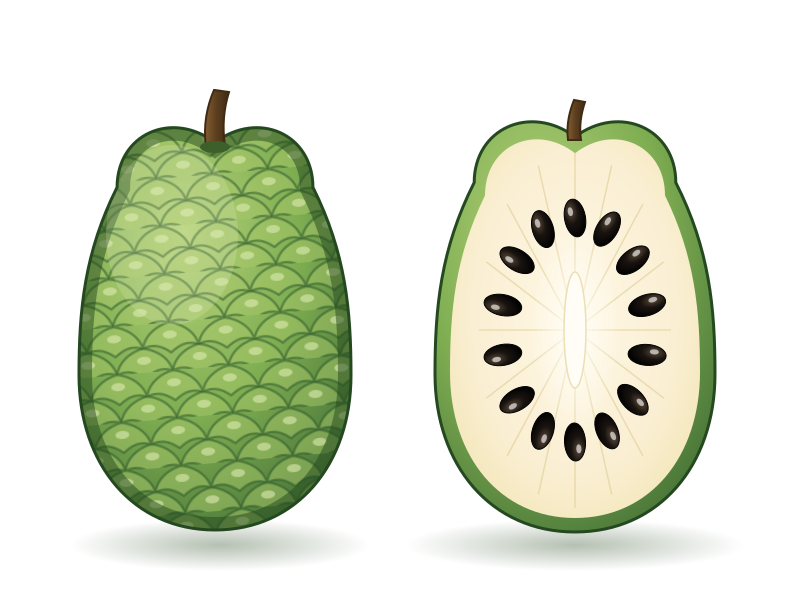
A three-dimensional cherimoya: a green, heart-shaped fruit with bumpy, scaly skin, turning slowly in dappled light. Sliced open, it shows snow-white creamy flesh with glossy black seeds tucked inside like beans.
Tell me more
Annona is a genus of roughly 170 species of trees and shrubs in the custard-apple family, Annonaceae; only a handful - among them cherimoya, soursop, sugar apple, custard apple and the atemoya hybrid - are farmed to any extent. The name is generally traced through Spanish anón to the Taíno word for the fruit.
“Custard apple” is a slippery name: in Britain it usually means the cherimoya (the RHS’s common name for Annona cherimola), in India the sugar apple and in Australia the atemoya, so this site calls each cousin by its own name and says “custard apple” only when a shop or a country does.
Keyboard: Tab to the fruit and use ← → to spin it. Enter slices it open.
Follow the seeds ↓
Behind the words: an Andean valley at sunrise. Pale blue peaks with snowy tips fade into the distance. Clouds drift by. Green ridges with terraced orchards rise in front as you scroll.
Where it all began
Our story starts high in the Andes, the long mountain chain of South America. For as long as anyone knows, cherimoya trees have grown wild in cool valleys in Ecuador and Peru. Near a town called Loja, whole groves of wild ones still grow today.
Cherimoyas like it cool, but not cold. They grow about 1,400 to 2,000 metres up the mountainside. People in the Andes say the tree can’t stand snow, but likes to see it from a distance.
Even the name is mountain-flavoured. It probably comes from Quechua, an old language of the Andes. Many people say chirimuya means “cold seeds”.
Ancient potters in Peru made clay pots shaped like Annona fruits. Are they cherimoyas or soursops? Fruit detectives are still arguing about it!
Slide the marker up the mountain and find out where a cherimoya is happiest.
Tell me more
Botanists have traditionally placed the cherimoya’s home in the inter-Andean valleys of Ecuador, Colombia and Peru, with a centre of diversity in southern Ecuador and northern Peru. In its native range it grows at roughly 1,400-2,000 m, where temperatures average 17-20 °C. It is a subtropical tree: it tolerates only light frost, needs a little winter chill, and does not succeed in the hot lowland tropics - the opposite of its strictly tropical cousin the soursop, whose young trees are killed by a few degrees of frost.
The origin story may be more tangled than the textbooks suggest. A 2017 study of 1,765 trees found more genetic diversity in Central America and proposed that people carried the fruit south to the Andes in pre-Columbian times. Whether cherimoya was eaten in Peru before the Spanish arrived is also debated: some archaeologists read the fruit-shaped Moche and Chimú pots as cherimoyas, while others argue those pots show soursop - recognisable by its small prickles - and that cherimoya reached Peru only around 1630.
What we do know: in 1629 the Jesuit chronicler Bernabé Cobo tasted the fruit in Guatemala and sent “a good quantity of its seeds” to a friend in Peru; thirteen years later he found many fruiting trees. In 1768 Philip Miller, head gardener of the Chelsea Physic Garden in London, gave it the scientific name Annona cherimola.
Keyboard: Tab to the slider and use ↑ ↓ to climb.
Behind the words: a big family tree. Eight little fruits fly out from the trunk to their own branches as you scroll, each cousin finding its place.
Meet the family
The cherimoya has a big family. There are about 170 kinds of Annona in the world. Only a handful are grown on farms; the rest are wild cousins hiding in forests and swamps.
The soursop is the giant of the family. It looks like a green dragon egg covered in spikes. Do not worry - the spikes are soft and bendy.
The sugar apple looks like lots of green knobbles stuck together. Inside it is white, soft and super sweet.
The atemoya is what you get when a cherimoya and a sugar apple have a baby. A plant scientist called P. J. Wester made the first one on purpose in 1908.
The pawpaw is the cousin who moved abroad. It is the only branch of the whole family that lives somewhere cool: North America.
“…the most delicious fruit known to men.”
Mark Twain, writing about the cherimoya from Hawaii in 1866
Flip the cards to meet each cousin. Pick two to compare them side by side.
Tell me more
The custard-apple family, Annonaceae, has about 107 genera and roughly 2,400 species, making it the largest family in the magnolia order. The genus Annona alone holds around 170 species, yet only a few are farmed to any extent: cherimoya, soursop, sugar apple, custard apple (bullock’s heart), the African wild custard apple, the wild red custard apple, soncoya and the atemoya hybrid, with biribá and ilama grown locally.
“Custard apple” is a slippery name. In Britain it usually means the cherimoya; in India it means the sugar apple (sitaphal); in Australia it is the atemoya; and in Julia Morton’s standard reference it is Annona reticulata, the bullock’s heart. The genus name Annona is generally traced through Spanish anón to the Taíno word for the fruit spoken on Hispaniola.
The atemoya is a cherimoya × sugar apple cross. P. J. Wester made the first deliberate hybrid in 1908 at the USDA’s subtropical laboratory in Miami, hoping to marry the cherimoya’s flavour with the sugar apple’s tolerance of tropical heat. The first fruit ripened not in Florida but in the Philippines, on 8 October 1913. Chance hybrids later appeared in Israel, in the 1930s or 1940s, where sugar apple and cherimoya orchards had been planted side by side.
Twain’s line comes from a letter to the Sacramento Daily Union, written at Kilauea in June 1866: “the pride of the islands, the most delicious fruit known to men, cherimoya, was not in season. It has a soft pulp, like a pawpaw, and is eaten with a spoon.” In Roughing It (1872) he called the chirimoya “deliciousness itself”.
Keyboard: Tab to a card, Enter to flip. Press Compare, then Enter on two cards. Escape cancels.
Behind the words: the fruit’s scaly green skin fills the view. As you scroll it zooms up and gives way to creamy white flesh with a ring of black seeds.
Inside the fruit
Outside, a cherimoya is green and bumpy, sometimes with marks like giant fingerprints. Inside, the flesh is snowy white and creamy. Shiny black seeds are tucked into it like beans.
Here is a secret: a cherimoya is not one fruit. It is lots of tiny fruits squashed together into one! Each bump on the skin is a little fruit with its own seed inside.
If a bump did not get pollinated, it shrinks. That is why some cherimoyas end up wonky.
Never eat the seeds. They are poisonous. Spit them out whole, never crush or chew them, and keep them away from your eyes. The bumpy skin is not for eating either - it is just the fruit’s coat.
Why is it so soft? Fruit cells are glued together by a jelly called pectin. As the fruit ripens, that glue loosens and starch turns to sugar. The flesh melts into something like sweet custard.
Peel it back. Tap the skin, the flesh, the seeds and the core to find out what each part does.
Tell me more
Botanically the fruit is a syncarp: the many separate carpels of a single flower fuse with the swollen receptacle into one fleshy mass, and each pollinated carpel holds one seed. Unfertilised carpels shrink, which is why poorly pollinated cherimoyas are lopsided. The sugar apple shows the structure most clearly - its loosely joined segments can be pulled apart with the fingers when ripe.
The seeds of every Annona species contain annonaceous acetogenins, and cherimoya seeds also carry several alkaloids. Morton records that soursop seed oil is “an irritant poison, causing severe eye inflammation”, that sugar-apple seed powder can cause blindness if it reaches the eyes, and that swallowing 0.15 g of the resin from cherimoya seeds produces atropine-like symptoms - dilated pupils, light sensitivity, vomiting. Always de-seed pulp before blending a juice or smoothie. For babies and under-fives, treat a whole seed like a whole nut: the NHS advises removing hard pips and stones from fruit and giving no whole nuts to children under five, because they can choke on them. If a seed does go down whole by accident, tell a grown-up; if there is tummy pain, vomiting, fever or the child cannot eat or drink, see a doctor straight away - and if in doubt, ask a doctor anyway.
Per 100 g, raw cherimoya provides about 75 kcal, 3 g of fibre, 12.6 mg of vitamin C, 0.26 mg of vitamin B6 and 287 mg of potassium (USDA); soursop has 66 kcal and rather more vitamin C, 20.6 mg. Of the three, sugar apple has the most vitamin C: 36.3 mg per 100 g - roughly nine times a peeled ordinary apple.
Keyboard: Tab to the Peel slider and use arrow keys. Tab to each part and press Enter.
Behind the words: dusk falls over a garden. Stars and a moon come out, a big green flower opens its three thick petals, and fireflies blink.
Pollination night
A cherimoya flower looks like a small, thick, green three-pointed star. It hangs downwards. Hidden inside are as many as two hundred tiny pollen-making stalks, wound round in a spiral.
Here is the clever bit: the flower changes sex! It opens as a girl flower first. About a day later it turns into a boy flower and puffs out pollen.
So it needs a helper to carry pollen from flower to flower. Not bees - beetles! Sap beetles are about as long as a grain of rice, small enough to crawl inside.
The flower opens just a crack, so a beetle has to squeeze in like a letter through a letterbox. Inside is a cosy, sweet-smelling hideaway. The beetles eat, rest and even meet a mate in there. Then they leave, with pollen stuck to their hairs like glitter.
Some wild cousins in Brazil go even further. Their big flowers warm themselves up at night to waft their smell to chunky scarab beetles.
In places like Spain and California there are hardly any of the right beetles. So people do the beetles’ job with a tiny paintbrush, one flower at a time.
Be the beetle. Steer from flower to flower before dawn: collect pollen from a boy flower, deliver it to a girl flower.
Tell me more
Annona flowers are protogynous: each flower is functionally female first and male afterwards. In cherimoya the female phase lasts roughly a day to a day and a half and the male phase fewer than eight hours. At the La Mayora research station in Spain the flower enters its female stage around midday and sheds pollen at about 17:00-18:00 the following day. Because the stigmas dry out before the anthers open, a flower can rarely pollinate itself - hence the need for a go-between.
The natural pollinators of cultivated Annonas are nitidulid sap beetles, 2-6 mm long, drawn by the flowers’ fruity, fermenting scent. In Florida only flowers that nitidulids had visited set fruit, and three to six beetles inside a flower gave a fruit-set probability above 70%. A survey of four cherimoya orchards in Japan recorded 569 visitors from 31 arthropod species - and not a single bee or butterfly.
The “night” properly belongs to the wild, large-flowered South American species, pollinated by night-flying Cyclocephala scarab beetles; Gottsberger measured their flowers heating by up to 10-15 °C above the surrounding air. Outside the Americas, where the right beetles are scarce, commercial growers pollinate by hand, brushing pollen from male-phase flowers onto the sticky stigmas of female-phase ones - a skill that on Spain’s Costa Tropical is passed from parents to children.
Keyboard: Arrow keys or WASD to steer. Space to start. On a phone, hold your finger where you want to go.
Behind the words: a sunny kitchen. Fruit, jars and a spoon sit on the worktop, steam rises from a pot, and confetti tumbles down as you scroll.
The Taste Lab
People say a cherimoya tastes like banana, pineapple and papaya all mixed together. The texture is like custard. That is why it is often called a custard apple!
Soursop is different. It smells a bit like pineapple but tastes tangy and sharp as well as sweet. Its name probably comes from an old Dutch word meaning “sour sack”.
The sugar apple lives up to its name - some are more than a quarter sugar. And the atemoya? People say it tastes of vanilla, pineapple and even a hint of wintergreen, a minty flavour.
How do you know one is ripe? Press it gently, like testing an avocado. If it gives a little and the green skin has gone dull, it is ready.
Then chill it, cut it in half and dig in with a spoon, like a pudding. Spit the big black seeds out as you go. It is allowed!
Mix banana, pineapple, strawberry, vanilla and lemon. Which cousin did you make? Then try the squeeze test.
Tell me more
Chemists have detected 92 volatile compounds in cherimoya. The most odour-active are fruity esters such as 3-methylbutyl butanoate - built on the same isoamyl alcohol as isoamyl acetate, the “banana” molecule - plus piney alpha-pinene. Soursop’s aroma is dominated by two methyl esters, methyl (E)-2-hexenoate and methyl hexanoate, the latter described as smelling of pineapple. Pineapple itself is ester-led, sharing the same family of short-chain butanoates and hexanoates, which is the chemical reason the three fruits rhyme.
Cherimoya is one of the few fruits that becomes more acidic as it ripens, while its starch turns to sugar - in ‘Concha Lisa’ fruit soluble solids rose from 6.8% to 18.2% in ten days - giving that sweet-sharp balance. Ripe soursop pulp carries roughly two to ten times cherimoya’s acidity, which is why it mostly ends up in drinks, ice cream and smoothies. Sugar apples range from about 12.6 to over 29 °Brix with only 0.26-0.67% acid.
In the kitchen: ripen a hard fruit on the worktop, where a cherimoya takes about 3-4 days, never in the fridge - the cold causes chilling injury, browning the skin and stopping proper ripening. Refrigerate only once it is soft. For near-instant ice cream, freeze de-seeded pulp with a splash of cream; for a Caribbean-style soursop drink, press the de-seeded pulp through a sieve, mix with water or milk and sweeten.
Keyboard: Tab to each slider and use arrow keys. For the squeeze test, hold Space on a fruit.
Behind the words: a map of the world. Dotted journey lines draw themselves from the Americas to Spain, India and the Philippines, and a ring marks Britain.
Around the world - and to Britain
In the 1700s cherimoya seeds sailed around the world on ships. They reached Spain in 1757, Jamaica in 1785 and Hawaii in 1790.
Guess where most of the world’s cherimoyas grow today? Not the Andes, but a sunny strip of coast in southern Spain.
Soursop was one of the first fruit trees to sail from the Americas to Africa and Asia. In Malaysia it is called “Dutch durian”, a name that remembers how it arrived.
India grows more sugar apples than anywhere else on Earth. There it is called sitaphal.
And Britain? Truth is, you will hardly ever see these fruits in a supermarket. When you do, the “custard apple” is nearly always a cherimoya grown in Spain. Look in autumn - most Spanish cherimoyas are picked between September and December.
Try a specialist online greengrocer, or a Caribbean or Indian grocer’s. One fruit can cost as much as a whole bag of ordinary apples, and shops often sell out. Caribbean shops also sell soursop juice in a can.
Tap a pin on the map. Which cousin grows there, and what do people call it?
Tell me more
Cherimoya reached Spain in 1757, Jamaica in 1785, Hawaii in 1790 and Italy in 1797; California’s first trees were planted at Santa Barbara in 1871. Spain is now the world’s largest producer: in 2022/23 Andalusia harvested 43,484 tonnes from 3,041 ha, 96% of that area on Granada’s Costa Tropical, whose fruit has carried an EU Protected Designation of Origin since 2010.
In Britain, “custard apple” is the RHS’s common name for Annona cherimola; when Asda became the first UK supermarket to stock it in 2012, it sold Spanish cherimoya as custard apple, two for £2.47. In September 2026 specialist online greengrocers listed fresh cherimoya at about £3.95-£11 a fruit, and Afro-Caribbean grocers and online shops listed fresh soursop from £13.95 - mostly sold out or on back-order. South Asian grocers sell the sugar apple as sitaphal or “custard apple”. A potted cherimoya will grow in a conservatory kept above 10 °C, but to get fruit you would have to hand-pollinate it.
Soursop bears the largest fruit in the genus. The Guinness World Records soursop reported in 2011 was a 3.69 kg fruit grown in Hawaii; a 6.98 kg specimen grown on Kaua‘i in 2016 was weighed and submitted, though its official status is unclear. Cherimoya champions at Peru’s Callahuanca festival have reached 4.7 kg - ten to thirty times the 150-500 g of a typical fruit.
A note for grown-ups about soursop. On the Caribbean island of Guadeloupe, doctors found that patients with an atypical form of parkinsonism ate significantly more soursop and drank more herbal tea than other patients. The suspect compound is annonacin, an acetogenin in the fruit and leaves, which damaged brain cells in rats and in cultured neurons. The estimate behind the concern was heavy, long-term use: an adult eating a whole fruit or a can of nectar every single day for a year. France’s food safety agency concluded in 2010 that the link is not proven in people and that no precise consumption limit could be set, while advising particular care with concentrated preparations such as leaf teas, extracts and supplements. Claims that soursop cures cancer are unsupported: Cancer Research UK says there is not enough reliable evidence, and the viral “10,000 times stronger than chemotherapy” story has been fact-checked as false.
Keyboard: Tab between pins and press Enter, or use Next stop.
Behind the words: a burgundy passport swings open on a desk with a pen and an ink pad. A fresh stamp appears inside as you scroll.
The Passport Office
You have climbed the Andes, met the family, peeled the fruit and flown with a beetle. You have tasted everything and travelled the world. Well done, explorer!
Now the Passport Office has ten questions for you. Some are about things you did on the way. Get enough right and you earn a certificate with your name on it.
Quick reminder before you go in. Beetles, not bees. Custard, not crunch. And never, ever eat the seeds.
Ready? Step up to the counter.
Tell me more
How the passport works: your stamps and answers live only in this page’s memory. Nothing is saved, sent or stored - close the tab and they are gone. Some of the quiz’s questions come from what you actually did in the exhibits, so your paper depends on your journey. When you pass, type your name and use your browser’s Print command; the page is styled so that only the certificate prints. “Read to me” uses your browser’s own speech voice, and this site asks for one stored on your device first; on some browsers the only voices available are streamed from the browser maker, in which case the story text is sent to them to be spoken.